

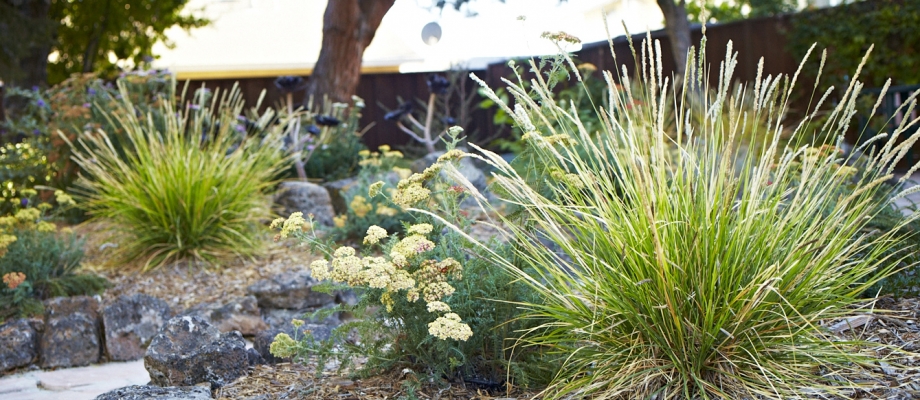

That water conservation is a necessary part of life in California is broadly understood. Less well-known is the fact that residential landscapes, which account for at least 30 percent of the water used in urban areas, are routinely overwatered. Most gardeners use about 40 percent more water than they need. Less water, and water at the right time, can mean a healthier, better-looking garden.
Conserving water is a natural part of Bay-Friendly Gardening. Choosing locally adapted plants is one important component; the Bay-Friendly Gardener can also use the techniques described below to make the most of this precious resource.
Use locally adapted plants. Plants that are well suited to conditions in Alameda County should be the principle building blocks of your Bay-Friendly Garden. Local natives have the virtue of living here naturally.
Learn how much water your plants need. General information about a plant’s water needs should be provided when you buy it. Look for signs of stress, such as leaf drop and leaf color change, which can occur from either from too little water or too much.
Group plants by water needs. This irrigation design, called hydrozoning, groups plants by their water, soil, and exposure needs.
Water according to need. The amount of water a plant needs changes over the course of the seasons. Day length, temperature, rainfall, and winds will all influence how much you should water and how often. Turn off fixed systems during the rainy season.
Monitor your soil. Soils influence a plant’s water needs, since their water-holding capacities differ. Use a spading fork or soil-sampling tube to examine the ground before and after you have watered. The goal is to water the entire depth of the root system.
Use compost to create drought-resistant soils. The organic content of soil affects its ability to hold moisture. Adding compost to your soil will increase its permeability and water-holding capacity.
Use mulch to prevent water loss. In addition to adding organic matter to the soil, mulch reduces the amount of moisture that soil loses through evaporation and plant transpiration, moderates the temperature of the soil in both summer and winter, protects irrigation components from the elements, and prevents weed growth.
Water to encourage deep root growth. Deeply rooted plants are better able to withstand the vagaries of wind and weather. A general rule of thumb is to water enough to wet a plant’s entire root zone.
Make every drop of irrigation water count. The best time to water is in the early morning. Be sure that all water falls on soil and plants, not sidewalks or other impervious surfaces. Also, give attention to how quickly your soil absorbs water. Observe your irrigation system in action and regularly check it for leaks.
Control weeds. Weeds compete with other plants for nutrients and water in the soil. Eliminating weeds from garden beds and lawns will make more resources available for your chosen plants.
Minimize the lawn. Lawns are heavy water users. Keep yours to a minimum, reserving it for children’s play areas or picnic areas in the backyard.
You can become a Bay-Friendly Gardener with these resources: