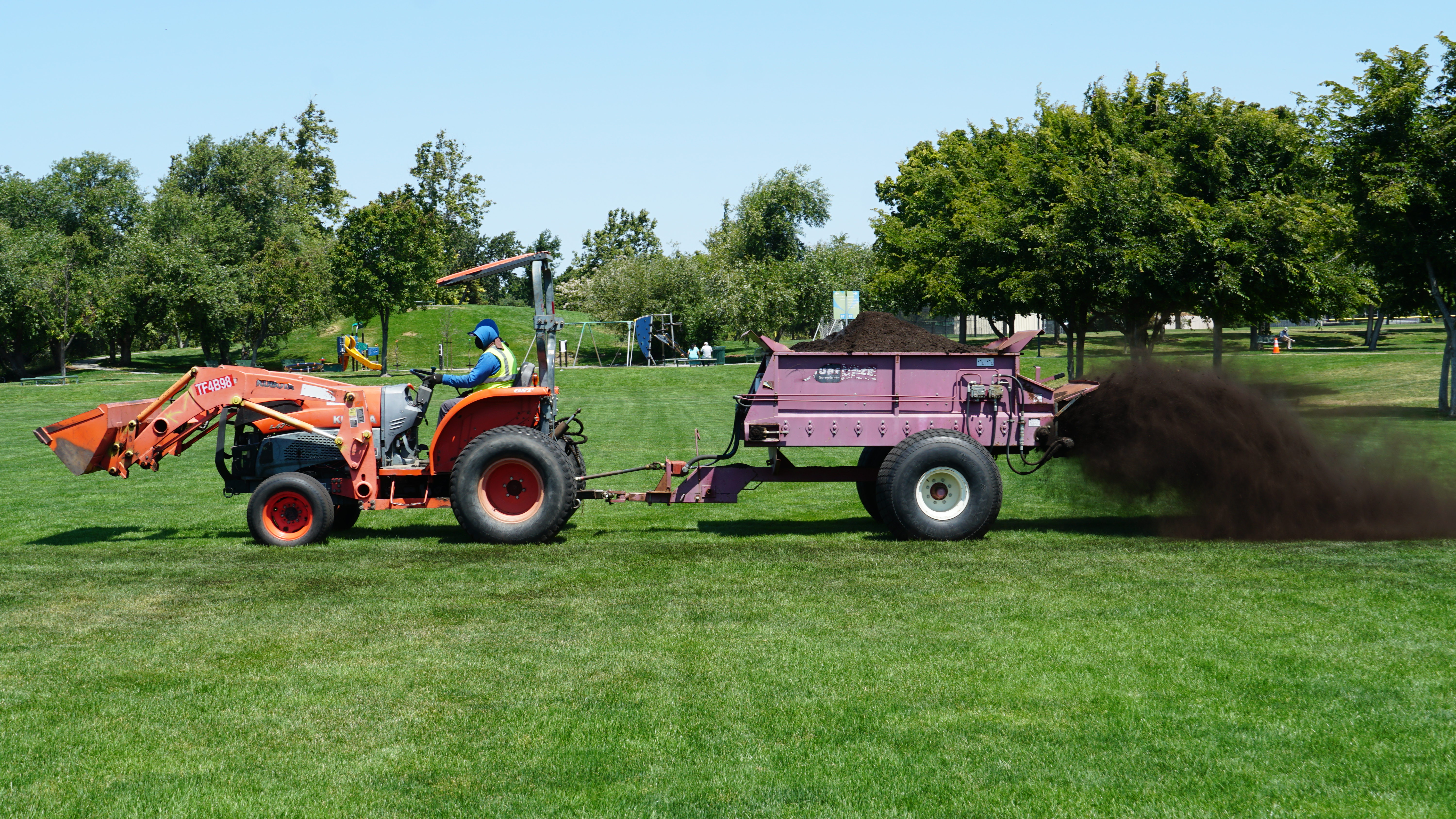
Cities are exploring new approaches to meet SB 1383 procurement requirements and implement Climate Action Plans, such as spreading compost on public parks, pictured here.
Carbon farming refers to land management practices that increase the ability of soil and plants to pull carbon dioxide from the atmosphere and sequester it deep in the soil, helping to reverse climate change. Applying compost increases the carbon stored in soils over time by improving soil health and water holding capacity, and feeding the soil ecosystem. This impact is in addition to the reduced methane emissions resulting from diverting organic materials from landfill to make the compost.
While carbon farming is often associated with agriculture, it holds the potential to be similarly impactful in a mostly dense, urban area like Alameda County. Local jurisdictions manage large parks and landscapes and have an opportunity to increase compost application as part of their maintenance practices, while supporting their Climate Action Plan goals and compliance with SB 1383 procurement requirements.
Until recently, there was very little research on how compost would affect soil carbon in urban landscapes, such as parks and sports fields. To address this gap, StopWaste partnered with UC Merced and the cities of Dublin and Pleasanton in 2022 to conduct a multi-year research effort, combining a field experiment, a greenhouse study, and a field survey of eight parks to measure short- (1-2 years) and long-term (20-30 years) impacts of compost on soil carbon sequestration and soil greenhouse gas emissions at city parks.
Key Findings
The research findings suggest compost application improves soil health in the near term while building meaningful climate benefits over time. Key findings include:
- Parks with 20–30 years of compost use have 19–30% greater soil carbon stocks down to 1 meter and 49–101% more mineralized carbon in the deep soil.
- Increases soil biological activity and boosts grass root biomass by up to 59%, helping move more carbon into the soil via plant photosynthesis.
- Reduces nitrous oxide emissions associated with fertilizer and recycled water use by up to 53%; nitrous oxide has a global warming potential 276 times that of carbon dioxide.
- Long-term compost applications resulted in adding 1 ton of soil carbon per acre per year.
Taken together, these findings point to compost application as a practical, scalable turf maintenance strategy for improving soil health and increasing carbon sequestration in urban landscapes.
Next Steps
The UC Merced research is expected to be published soon, and in the meantime, StopWaste is sharing these findings with member agencies and partners and continuing technical assistance to support expanded compost use. This work will help jurisdictions meet procurement requirements and support carbon sequestration goals identified in their Climate Action Plans. By applying compost to public landscapes, jurisdictions can improve soil health, reduce greenhouse gas emissions, and sequester carbon over time—turning our favorite recreation spaces into part of the climate solution.
Visit our carbon farming pages for additional information.