StopWaste advocates for state and local policies that advance environmental sustainability across Alameda County. Our priorities are organized around three strategic goals and reflect where we are actively engaging legislators, shaping regulations, and building coalitions in 2026. For an overview of the laws and ordinances StopWaste administers and implements, see State & Local Lawmaking.
Resource List
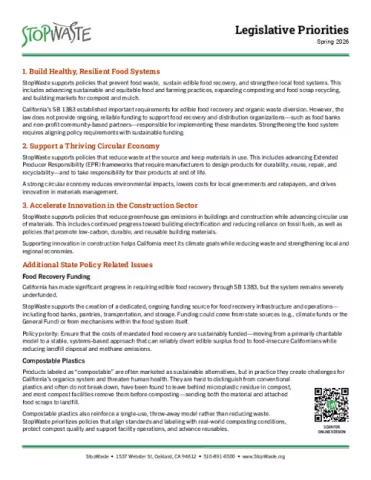
StopWaste Legislative Priorities - 2026
Build Healthy Food Systems
A strong local food system minimizes waste while promoting health and access to nutritious food. StopWaste supports policies that advance food waste prevention, strengthen food donation and recovery, and build sustainable markets for compost and mulch.
Stable Funding for Food Recovery
Food recovery organizations across California face persistent funding shortages that threaten their ability to meet the edible food recovery requirements of SB 1383. Through the Alameda County Food Recovery Network — a coalition of over 55 local organizations — more than 6,000 tons of edible food are recovered annually, equivalent to approximately 10 million meals. Many of these organizations operate with minimal staff and depend on volunteers. StopWaste is advocating for stable, dedicated funding through statewide CalRecycle grant programs and building legislative support for the case that keeping edible food out of landfills benefits food-insecure communities and reduces methane emissions.
Food Bank Donation Incentives
SB 353 and SB 881 would extend state income tax credits for taxpayers donating fresh produce and agricultural foods to food banks through 2032. StopWaste supports both bills because they incentivize food donations that directly complement SB 1383 food recovery goals.
Support a Thriving Circular Economy
A circular economy reduces waste and resource dependence by keeping materials in circulation as long as possible. StopWaste supports policies that expand producer responsibility, strengthen compost markets, and advance reuse systems.
Protecting the Organics Stream from Compostable Plastics
Current forms of compostable plastics pose a growing challenge: they contaminate compost, contribute to single-use disposable culture, and raise health and environmental concerns about the finished product. StopWaste is educating legislators on these impacts and working with advocacy partners to support legislative solutions that minimize contamination.
Accelerate Innovation in the Construction Sector
The construction sector contributes nearly 40 percent of global energy-related carbon emissions. StopWaste supports policies that reduce both operational and embodied carbon in buildings.
Building Electrification
California's 2025 Energy Code, now in effect, establishes an all-electric baseline for space and water heating in new construction. The updated CALGreen code introduces mandatory embodied carbon requirements for large commercial and school projects.
StopWaste advances the clean energy transition through the Bay Area Regional Energy Network (BayREN), leading the regional Multifamily program and the statewide Green Labeling program — which is expanding in 2026 as the first non-utility ratepayer-funded program to operate at the state level. Through the Bay Area Construction Innovation Cluster, StopWaste promotes sustainable building materials, deconstruction and reuse practices, and low embodied carbon industrialized construction methods.
Our Advocacy Partners
StopWaste works in coalition with organizations including Californians Against Waste (CAW), the California Product Stewardship Council (CPSC), the National Stewardship Action Council (NSAC), the California State Association of Counties (CSAC), CalCities, the Rural County Representatives of California (RCRC), the Local Government Sustainable Energy Coalition (LGSEC) and the Building Decarbonization Coalition (BDC). Representatives from our member agencies convening as the Technical Advisory Committee (TAC), and the Energy Council’s Technical Advisory Group (TAG), play an essential role in providing feedback on draft regulations and shaping our policy positions.