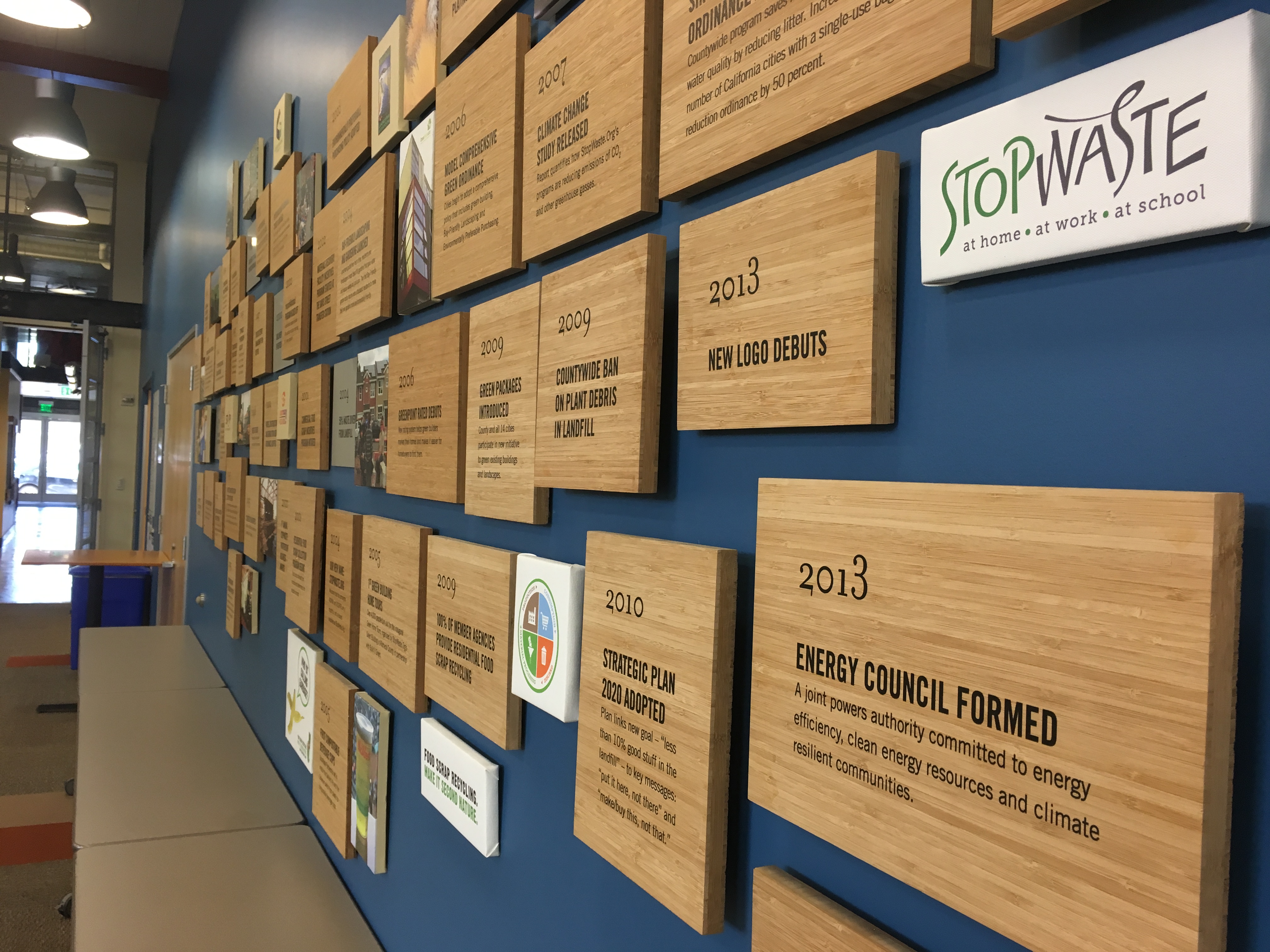
Our work began in 1976 with the founding of the Alameda County Waste Management Authority. In 1990, Alameda County voters overwhelmingly approved the Measure D ballot initiative that created the Alameda County Source Reduction and Recycling Board. At that time, only 14 percent of discarded materials were diverted from the county's landfills.
We've come a long way since then. Alameda County now has one of the largest food scrap recycling programs in the country. Plant debris is banned from landfills, and construction and demolition debris accounts for only 12 percent of the county's waste stream, down from 21 percent in 2010.
From 2022 to 2025, the Agency undertook a comprehensive priority-setting process that culminated in three primary Goals, Focus Areas, and Initiatives — a Thriving Circular Economy, a Healthy Local Food System, and an Innovative Bay Area Construction Sector. As we mark our 50th anniversary in 2026, these goals guide our strategy and programming for the years ahead.
As we work toward these goals, it's worth taking a look back at some of the initiatives that have made Alameda County a national leader in waste prevention.
The Circular Economy Era — 2013 to Present
StopWaste's mission expanded well beyond recycling and proper sorting in this period — into energy, food systems, reusables, and sustainable building practices.
2025 —
2024 —
2023 — California signs AB 1572, banning the use of potable water to irrigate non-functional turf at commercial and institutional properties.
2022 — State law SB 1383 goes into effect to reduce methane emissions by mandating organics be kept out of landfills and edible food be recovered and donated. SB 54 is signed, setting a 25% reduction target for single-use plastic packaging by 2032 with $5 billion in industry funding. StopWaste adopts ORRO, the local organics reduction and recycling ordinance.
2021 — StopWaste adopts new aims and guiding principles centering equity and prioritizing partnerships, regenerative solutions, and capacity building.
2020 — Mandatory Recycling and Composting Ordinance for businesses and multifamily buildings in effect across all jurisdictions.
2020 — StopWaste's building becomes the first public building in California to receive Fitwel's 2-Star Certification for promoting employee health and well-being.
2019 — Began implementation of Carbon Farming Plan on Agency's rangeland property in partnership with the Alameda County Resource Conservation District.
2019 — American Council for an Energy-Efficient Economy honors Bay Area Regional Energy Network (BayREN) Multifamily program with an Exemplary Program Award.
2018 — Permanent conservation easement established on Agency property, dedicating 160 acres in the Altamont Hills to protect and preserve natural wildlife.
2017 — Launched K-12 school food share and donation program, reducing wasted food in cafeterias.
2017 — Countywide expanded reusable bag ordinance goes into effect, applies to all stores and restaurants in the county.
2016 — CalEPA honors StopWaste with a Governor's Environmental and Economic Leadership Award for its multi-step environmental education program.
2014 — Household hazardous waste program expands days, hours, and adds public events.
2014 — StopWaste building awarded LEED-EB v4 Platinum for Operations & Maintenance — the first v4 Platinum certification in the world.
2013 — StopWaste's Board approves creation of the Energy Council, a joint powers authority committed to energy efficiency and clean energy.
2013 — StopWaste helps establish BayREN, a collaboration of nine Bay Area counties.
The Green Innovation Era — 2000 to 2012
This is the period where StopWaste built many of the programs that define us — often well ahead of the curve.
2012 — Countywide reusable bag ordinance prohibits free distribution of single-use bags in about 1,300 stores.
2012 — Mandatory recycling adopted for businesses and multifamily buildings in most parts of the county.
2011 — Ready Set Recycle is launched, an innovative campaign and contest that uses recognition, rewards, and reinforcement to help make proper sorting the norm.
2010 — Strategic Plan is adopted with a new waste diversion goal: by 2020, less than 10 percent of what winds up in Alameda County's landfills will be readily recyclable or compostable.
2009 — Plant Debris Landfill Ban prohibits grass cuttings, tree trimmings, and other plant waste from disposal in county landfills.
2009 — Alameda County and all 14 cities participate in the new Green Packages initiative to green existing buildings and landscapes.
2007 — StopWaste's office is the first renovated building in the country to earn LEED Platinum certification.
2004 — Bay-Friendly Landscaping & Gardening program gets off the ground, providing education, technical assistance, and other resources.
2002 — irecycle@school! program kicks off, bringing technical assistance, educational resources, teacher training, and service-learning projects to the county's 350 public schools.
2001 — Curbside residential food scrap recycling begins in many of the county's cities. Today, the county has one of the largest food scrap recycling programs in the country — two decades before the state mandated it.
2000 — Green Building in Alameda County program launches, with the goal of motivating residents, cities, property owners, and the building industry to reduce construction waste.
Laying the Foundation — 1976 to 1999
The early years established the governance, funding, and first programs that everything else would build on.
1997 — County adopts its first comprehensive source reduction and recycling plan.
1995 — StopWaste Business Partnership starts up, offering recycling and waste prevention assistance.
1995 — Education Center at Davis Street opens to provide tours to schools in partnership with Waste Management, Inc.
1994 — Household hazardous waste program is created to give residents a convenient way to safely dispose of pesticides, cleaners, and other potentially toxic household waste.
1991 — Composting at home is promoted to reduce the volume of plant trimmings and food scraps sent to the county's landfills.
1990 — Alameda County voters approve Measure D, the Alameda County Waste Reduction and Recycling Act, with the goal of reducing waste by 75 percent by 2010. ACWMA operates as a separate agency from County Planning when it assumes responsibility for the CoIWMP and begins collecting fees to fund programs.
1989 — California Legislature passes AB 939, which requires every city in California to reduce garbage to landfill by 25% by 1995 and 50% by 2000.
1976 — Alameda County Waste Management Authority is formed to provide waste management planning and programs in Alameda County.
From a single planning mandate to an agency working across waste, food, energy, construction, and policy — each era built on the last. The programs proved what was possible, and those results helped shape the laws that now guide the state.
Here's to the next fifty!